
FRCR pass rates vary widely from sitting to sitting: in the RCR’s published figures, all-candidate physics pass rates ranged from 39.4% to 71.1% across the 2024 and 2025 sittings, and in recent Part 2A sittings roughly six in ten candidates passed. The figures come from the RCR’s Clinical Radiology Pass Rates Report, which splits results into four groups.
This guide covers the published FRCR pass rates for Part 1 anatomy, Part 1 physics and Part 2A, what the Global and UK groups mean, how the pass mark is set, and what the numbers mean for doctors in India and the Gulf.
Table of Contents
How to read FRCR pass rates
The Royal College of Radiologists publishes these figures in its Clinical Radiology Pass Rates Report: 2021 to 2025. Each figure is a pass rate percentage followed by the number of candidates in brackets, and the tables below keep that format.
The report uses four groups, and the labels are the RCR’s own:
| Group | What it covers |
| All candidates | Everyone who sat that exam at that sitting |
| UK trainees | Candidates in the RCR’s UK trainee group |
| UK 1st attempt | UK trainees sitting for the first time |
| Global | Candidates outside the UK trainee groups, as the RCR labels them |
We use only the 2024 and 2025 sittings here. In 2021 several exams were cancelled or rescheduled because of COVID-19, as the report notes, so older figures are a poor guide to the current exams.
Part 1 anatomy pass rates
Anatomy is the image-based Part 1 module: 100 images in 90 minutes on the Assess platform. These are the published figures.
| Sitting | All candidates | UK trainees | UK 1st attempt | Global |
| Mar 2024 | 79.9 (796) | 86.0 (351) | 86.9 (343) | 75.1 (445) |
| Jun 2024 | 70.5 (522) | 80.0 (50) | 71.4 (7) | 69.2 (468) |
| Sep 2024 | 48.8 (637) | 22.2 (18) | 100 (3) | 49.6 (619) |
| Mar 2025 | 71.6 (932) | 81.1 (338) | 81.3 (327) | 66.2 (594) |
| Jun 2025 | 76.2 (642) | 83.6 (67) | 55.6 (9) | 75.3 (575) |
| Sep 2025 | 78.3 (667) | 93.3 (15) | n/a (0) | 77.9 (652) |
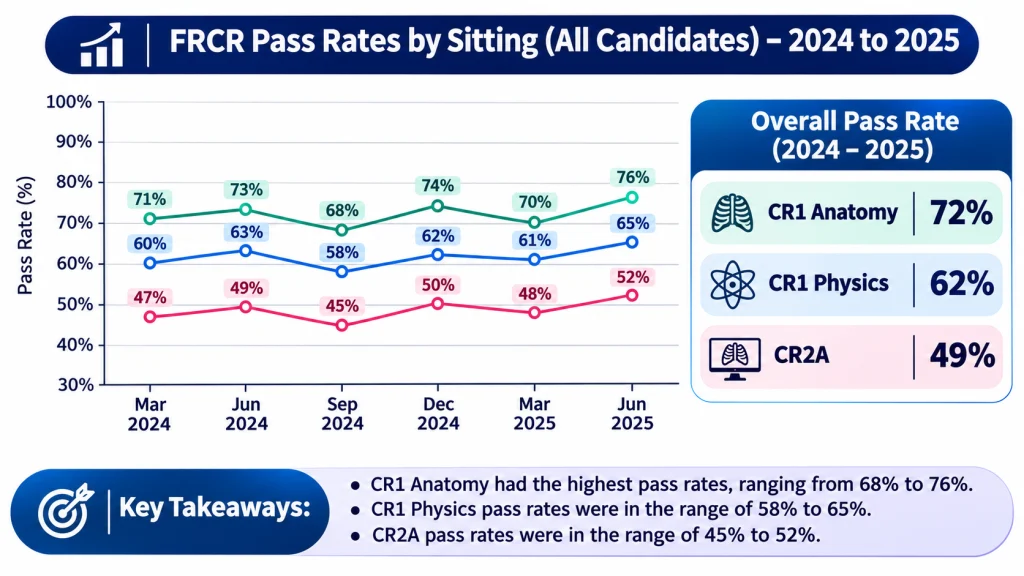
The Global anatomy pass rate ran from 49.6% (September 2024) to 77.9% (September 2025). The spread is the point: one sitting’s result tells you little about the next. Our FRCR anatomy guide covers how to prepare for the image format.
Part 1 physics pass rates
Physics is the true/false module: 40 questions, each with five items, in two hours on Speedwell. Its FRCR pass rates show the widest swings of the three exams in this guide.
| Sitting | All candidates | UK trainees | UK 1st attempt | Global |
| Mar 2024 | 60.3 (802) | 83.6 (359) | 84.9 (350) | 41.5 (443) |
| Jun 2024 | 70.3 (549) | 81.5 (54) | 50.0 (4) | 69.1 (492) |
| Sep 2024 | 39.4 (673) | 31.8 (22) | 100 (4) | 39.6 (651) |
| Mar 2025 | 71.1 (927) | 89.2 (344) | 89.1 (330) | 60.4 (583) |
| Jun 2025 | 63.6 (613) | 76.5 (34) | 50 (6) | 62.9 (579) |
| Sep 2025 | 48.1 (700) | 58.3 (12) | 100 (1) | 48.0 (688) |
For Global candidates, physics ranged from 39.6% to 69.1% across these sittings. In March 2024 and March 2025, the large UK trainee groups passed physics at a noticeably higher rate than the Global group, which is a reminder to give physics proper time. Our FRCR physics guide sets out an eight-week plan.
Part 2A pass rates
Part 2A is two papers of 120 single best answer questions, treated as one assessment. Across the four recent sittings, all-candidate pass rates stayed in a narrower band, roughly six in ten.
| Sitting | All candidates | UK trainees | UK 1st attempt | Global |
| Apr 2024 | 65.8 (666) | 55.3 (197) | 53.5 (71) | 70.1 (469) |
| Nov 2024 | 65.2 (1035) | 66.2 (420) | 71.2 (340) | 64.6 (615) |
| Apr 2025 | 59.8 (639) | 55.8 (181) | 58.1 (43) | 61.7 (458) |
| Nov 2025 | 62.3 (1069) | 67.6 (411) | 74.2 (330) | 59.0 (658) |
Unlike Part 1, the Global group in 2A was not consistently behind the UK groups; in April 2024 and April 2025 its pass rate was higher than the UK trainee figure. Part 2B, which changed in 2025, also varied, from 38.7% (October 2025) to 65.0% (March 2025) for all candidates across the 2024 and 2025 sittings. See our FRCR Part 2A exam guide for the format.
Global and UK groups: reading the numbers carefully
The most important caution with FRCR pass rates is group size. Some UK groups in the June and September sittings had single-digit candidate numbers, so a figure such as 100% or 50% can reflect three or four people. Do not quote those UK percentages on their own.
Look at the candidate numbers before the percentage. In September 2024 anatomy, for example, the UK 1st attempt figure of 100% came from three candidates, while the Global figure of 49.6% came from 619. The larger groups give a far steadier picture.
The report also does not separate Indian or Gulf candidates. You will see claims online about pass rates “for Indian doctors”, but the RCR’s report gives no country breakdown, so treat any such figure with suspicion.
How the pass mark is set
The pass mark is not a fixed percentage. For each Part 1 module, the RCR sets it using a modified Angoff method, and the final pass mark is decided after the exam using the Hofstee compromise method. The RCR says the cohort and pass rate vary from sitting to sitting.
For Part 2A, the pass mark also uses a modified Angoff method, with the highest and lowest scorers removed, and the Hofstee compromise method after the exam. Questions that perform poorly can be removed after review, and the pass mark is adjusted.
The RCR does not publish a single pass mark number, so ignore anyone who quotes one. After Part 1, your results letter shows your module scores and the level needed to pass at that sitting, which is the figure that matters for you. Our FRCR results guide explains how results are released.
What FRCR pass rates mean for Indian and Gulf candidates
For doctors in India and the Gulf, these figures are a planning tool, not a prediction. The sensible reading is that any single sitting can go against you, so prepare thoroughly and build a possible resit into your plan from the start.
Practical steps that follow from the figures:
- Give physics its own protected block of weeks, especially if your training has focused on clinical reporting.
- Plan Part 1 modules so a resit still fits the four-year rule, and keep the seven-year windows in mind for 2A and 2B.
- Use the RCR’s official specimen questions early, then practise under real timing.
- Book as soon as your window opens; bookings close at least eight weeks before each exam.
- Remember the maximum of six attempts at any FRCR exam; cancellations and withdrawals do not count.
A failed sitting is information. Look at your module scores against the level needed to pass, find the gap and plan the next attempt from there. If you want structured help, StudyFRCR has courses for FRCR Part 1 and FRCR Part 2A; see each course page for what it includes. Our Part 2B course is launching later: register your interest.
Frequently asked questions
Where do FRCR pass rates come from?
They come from the RCR’s Clinical Radiology Pass Rates Report: 2021 to 2025. The report groups candidates as all candidates, UK trainees, UK 1st attempt and Global.
What was the Part 2A pass rate in 2025?
For all candidates it was 59.8% in April 2025 and 62.3% in November 2025. Recent sittings have hovered around six in ten.
Is physics harder to pass than anatomy?
Physics pass rates swung more, from 39.4% to 71.1% for all candidates across 2024 and 2025. The all-candidate anatomy figure was higher at every one of those sittings, though sometimes only slightly.
Are there FRCR pass rates for Indian candidates?
No. The RCR report does not separate Indian or Gulf candidates, so any country figure you see is not from the RCR.
What is the FRCR pass mark?
There is no fixed number. The RCR sets it each sitting using a modified Angoff method and the Hofstee compromise method.
What does “Global” mean in the report?
It is the RCR’s label for candidates outside the UK trainee groups. We use the term exactly as the RCR does.
Ready to plan around the numbers? Explore the FRCR Part 1 course or Talk to our FRCR team.
Related guides: FRCR results · FRCR Part 1 preparation · FRCR 2A preparation · FRCR preparation
Sources: RCR: Clinical Radiology Pass Rates Report 2021 to 2025 · RCR: CR1 guidance notes for candidates · RCR: CR2A guidance notes for candidates · RCR: exam regulations and policies