

Good FRCR 2A preparation means covering every body system against the RCR curriculum, practising single best answer questions under exam timing, and using your daily reporting list as revision. For a doctor working full time, 12 to 16 focused weeks is a realistic window once the core reading is in place.
This guide covers 16-week and 12-week plans by system, SBA technique, how to use your reporting work, choosing a question bank, mock papers and timing, the final weeks and the mistakes to avoid.
Table of Contents
Start your FRCR 2A preparation with the format
Begin with the exam itself: two papers of 120 single best answer questions, three hours each, with no negative marking and all 240 questions treated as one assessment. Each question has a stem and five options, and you pick the best one. Three hours for 120 questions gives you 90 seconds per question.
The RCR describes the content as all aspects of clinical radiology plus the basic sciences of physics, anatomy and techniques. Its guidance notes group the clinical areas as cardiothoracic and vascular; musculoskeletal and trauma; gastro-intestinal; genito-urinary, adrenal, obstetrics and gynaecology and breast; paediatric; and central nervous and head and neck. Our FRCR Part 2A exam guide covers the format, marking and entry rules in full.
Before you plan a single week, download the official resources from the RCR’s CR2A page: specimen questions, the page on understanding the SBA format, TNM staging guidance and the candidate reference sheet. Sit the specimen questions cold. Your score by system is the most honest starting point you will get.
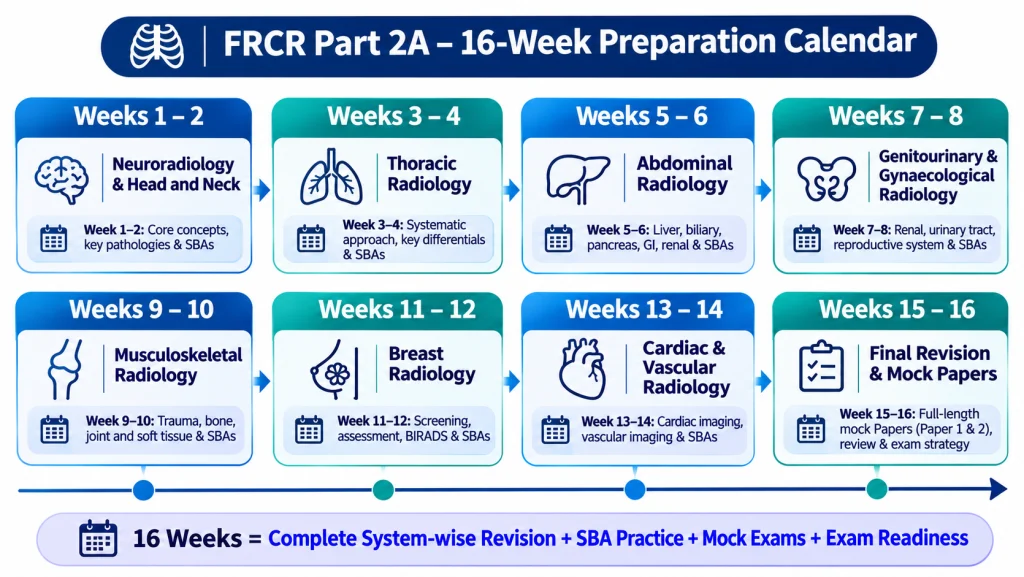
A 16-week FRCR 2A preparation plan
A 16-week plan suits you if you are on a busy rota or coming back to broad clinical radiology after a subspecialty-heavy year. It gives each system two weeks and leaves room at the end for full mock papers.
| Weeks | Focus | Output by the end |
| 1 to 2 | Specimen questions, guidance notes, reference sheet, TNM staging guidance | Baseline score by system; error log set up |
| 3 to 4 | Cardiothoracic and vascular | Two timed blocks of mixed questions |
| 5 to 6 | Musculoskeletal and trauma | Error log reviewed; weak topics listed |
| 7 to 8 | Gastro-intestinal | One timed half-paper |
| 9 to 10 | Genito-urinary, adrenal, obstetrics and gynaecology, breast | Two timed blocks |
| 11 to 12 | Paediatric | First full 120-question mock |
| 13 to 14 | Central nervous and head and neck | Second full mock; revisit weakest two systems |
| 15 | Physics, anatomy and techniques in clinical context; mixed revision | Two mocks on consecutive days |
| 16 | Error log, reference sheet, rest and logistics | Light timed sets only |
Keep roughly a third of each week for mixed questions from systems you have already covered. Spaced review stops early topics fading while you work through later ones.
A 12-week plan if your sitting is close
A 12-week plan works if your Part 1 knowledge is fresh and you report across several systems already. It compresses systems you see daily and keeps two weeks for mocks.
| Week | Focus |
| 1 | Baseline specimen questions; guidance notes and reference sheet |
| 2 to 3 | Cardiothoracic and vascular |
| 4 | Musculoskeletal and trauma |
| 5 | Gastro-intestinal |
| 6 | Genito-urinary, adrenal, obstetrics and gynaecology, breast |
| 7 | Paediatric |
| 8 to 9 | Central nervous and head and neck |
| 10 | Basic sciences and techniques; weakest system |
| 11 | Full mock papers on consecutive days |
| 12 | Error log, light timed sets, travel and documents |
For the April 2027 sitting, papers are on 20 and 21 April, and bookings close on 19 February 2027. Counting back, a 16-week plan would start in late December and a 12-week plan in late January. Check the FRCR exam dates page and book early, as late entries are not accepted.
Single best answer technique
Strong single best answer technique is about reading the stem with purpose. These habits work for most question styles:
- Read the final line first so you know whether you are being asked for a diagnosis, the next investigation or the best descriptor.
- Underline, mentally, the discriminating details: age, sex, history, enhancement pattern, location.
- Form your own answer before looking at the options, then find the closest match.
- If two options remain, ask which one fits every detail in the stem, not just the striking one.
- Answer every question. There is no negative marking, so a blank is always a lost mark.
Pacing is the other half. Aim for about 40 questions an hour, flag anything that takes longer than two minutes and come back to it. Change a first answer only when you spot a detail you missed, not because the option “feels” wrong on a second look.
Use the reference sheet in practice too. Knowing what normal ranges and abbreviations it gives you means you stop wasting memory on them and recognise them quickly on the day.
Using your daily reporting list
Your reporting list is the best revision resource you already have, because 2A asks for the same kind of clinical judgement you make on your worklist. Each day, pick two or three studies and ask yourself the questions an examiner would: what is the single most likely diagnosis, what is the key differential, and what would you recommend next?
Keep a short teaching file of these cases, sorted by system. When you revise that system in your plan, review the file alongside your questions. Discussing a tricky case with a consultant for five minutes often fixes a concept faster than an hour of reading.
If your current post is weighted towards one subspecialty, be deliberate about the gaps. Ask to sit in on lists or meetings in areas you rarely report, such as paediatrics or breast.
Question banks and mock papers
Choose one main question bank and use it well rather than collecting several. A good bank gives clear explanations, lets you filter by system and tracks your scores, so you can see whether your weakest area is improving.
Use it in two modes. Early on, untimed sets with full explanation reading build knowledge. From the halfway point, switch to timed blocks so the 90-second rhythm becomes automatic. Log every wrong answer with one line on why you missed it: knowledge gap, misread stem or poor elimination.
Full mock papers matter because three hours is long. Sit at least two full 120-question mock papers, ideally on consecutive days as in the real exam, and review them the following day. If you want structured support, StudyFRCR has an FRCR Part 2A course; see the course page for what it includes.
Final weeks and common mistakes
The final two weeks are for consolidation, not new textbooks. Work through your error log, re-sit questions you got wrong, keep timed sets short and protect your sleep before both papers.
Sort the practical details early. If you are not registered with the GMC, you sit in the name on your passport, and a passport is expected when you sit outside your country of residence. No Gulf venue is listed for CR2A, so doctors in the UAE, Qatar, Saudi Arabia, Oman, Kuwait or Bahrain need travel booked to Hyderabad or another listed venue; our FRCR exam centres guide helps with planning.
The mistakes that cost the most marks in FRCR 2A preparation are predictable:
- Reading by textbook chapter without timed questions until the last month.
- Skipping systems you rarely report and hoping they do not appear.
- Sitting no full-length mocks, so fatigue in hour three comes as a surprise.
- Hoarding question banks and finishing none.
- Leaving booking, travel and documents to the final weeks.
If you are planning the whole journey from Part 1 onwards, read our FRCR preparation guide. Part 2B follows once you pass 2A; our Part 2B course is launching later: register your interest.
Frequently asked questions
How long should FRCR 2A preparation take?
For a working doctor, 12 to 16 focused weeks is a realistic window. Allow longer if your current post covers only a few systems.
How much time do I get per question in Part 2A?
Each paper is three hours for 120 questions, so about 90 seconds per question. Aim for roughly 40 questions an hour.
Should I guess if I am unsure?
Yes. There is no negative marking, so always choose an answer before moving on.
How many mock papers should I sit?
Sit at least two full 120-question mock papers, ideally on consecutive days. Review each one the following day.
Do I need to memorise normal ranges?
A reference sheet with normal ranges and common abbreviations is provided in the exam. Practise with it so you know what it covers.
Can I start 2A revision before my Part 1 result?
You can start reading, but you can only enter once you have passed all of the First FRCR. Check the entry rules on the RCR CR2A page before you book.
Ready to plan your weeks? Explore the FRCR Part 2A course or Talk to our FRCR team.
Related guides: FRCR Part 2A exam format · FRCR preparation · FRCR pass rates · FRCR eligibility
Sources: RCR: FRCR Part 2A (CR2A) · RCR: CR2A guidance notes for candidates · RCR: exam regulations and policies