
FRCR physics is the Part 1 module of 40 questions, each with five true/false items, in two hours, and the single most useful thing to know is that it has no negative marking, so you should answer every item. Pass it by building real understanding topic by topic, then drilling true/false items under time pressure.
This guide covers the format, a true/false strategy, how to approach the topics, an eight-week plan, a question-practice method, common traps and timing on the day.
Table of Contents
How the FRCR physics module is set out
The paper has 40 questions, delivered on Speedwell, with two hours to complete them. Each question has a stem followed by five items, (a) to (e), and you mark each item true or false. Any number of items can be true, including all five or none at all, so every item is a separate decision worth one mark.
That gives 200 marks available. A correct item scores one, a wrong item scores zero and nothing is deducted. No calculator is needed. Physics is one of the two First FRCR modules alongside anatomy, and you can sit it at the same sitting as anatomy or separately, in either order; see our FRCR Part 1 exam guide for the full picture.
The RCR publishes how the 40 questions are spread across topics.
| Topic | Questions |
| Matter and radiation | 3 |
| Radiography and fluoroscopy | 6 |
| Radionuclide imaging | 6 |
| Radiation safety | 6 |
| Computed tomography | 6 |
| Magnetic resonance imaging | 6 |
| Ultrasound | 6 |
| Other | 1 |
The pass mark is set for each module by a modified Angoff method, with the final mark decided after the exam using the Hofstee compromise method. There is no fixed published number, so aim to know the material well rather than chasing a target score.
True/false strategy: answer every item
The core FRCR physics rule is simple: never leave an item blank. With no negative marking, a guess can only gain you a mark, and the RCR itself encourages candidates to answer every question.
Answering everything does not mean guessing carelessly. Work through each stem in three passes.
First, mark the items you are confident about. Second, reason through the ones you half know, using first principles: if a statement implies that a larger value of something must produce a better image with no trade-off, be suspicious, because imaging physics is full of trade-offs. Third, commit to an answer for anything left, before you move on.
Treat each item independently. A stem where you have already marked four items true does not make the fifth more likely to be false. That instinct to “balance” answers is a trap in a format where all-true and all-false stems are both allowed.
Approaching the topics
The physics module rewards understanding of how each modality works, how image quality is traded against dose or time, and how radiation is used safely. Use the RCR’s guidance notes and physics specimen questions, listed under candidate resources on the CR1 exam page, as your checklist alongside the published topic split, and tick topics off as you can explain them aloud without notes.
A few points from the guidance notes shape your reading. Syllabus sections 4.22 to 4.24, covering molecular imaging, are not currently examined. Physics questions are based on IRR17 and IR(ME)R 2017, so make sure your notes reflect those regulations rather than older ones.
For each modality, build the same mental framework: how the signal is produced, how it is detected, what determines resolution and contrast, what creates artefacts and what governs dose or safety. Once you can run through that framework for CT, MRI, ultrasound, radiography and nuclear medicine, true/false items become much easier to judge. The broader curriculum is on the RCR’s clinical radiology curriculum page.
An 8-week FRCR physics plan
This plan assumes around eight to ten hours a week alongside your rota. If you are sitting anatomy at the same time, run it in parallel with daily image practice; our FRCR Part 1 preparation guide shows how to combine the two.
| Week | Main topics | Practice target |
| 1 | Matter and radiation, X-ray production and interactions | 10 stems a day on the week’s topics |
| 2 | Radiography and fluoroscopy, image quality, dose | 10 stems a day, start an error log |
| 3 | Computed tomography | 15 stems a day |
| 4 | Ultrasound | 15 stems a day, revisit error log |
| 5 | Magnetic resonance imaging and MR safety | 15 stems a day |
| 6 | Radionuclide imaging, radiation safety and regulations | 20 mixed stems a day |
| 7 | Weak topics, official specimen questions | One full 40-question timed paper |
| 8 | Error log review, second timed paper, rest | Light review in the last two days |
Keep the RCR’s FRCR physics specimen questions back until week seven so they act as a genuine test rather than familiar material.
A question-practice method that works
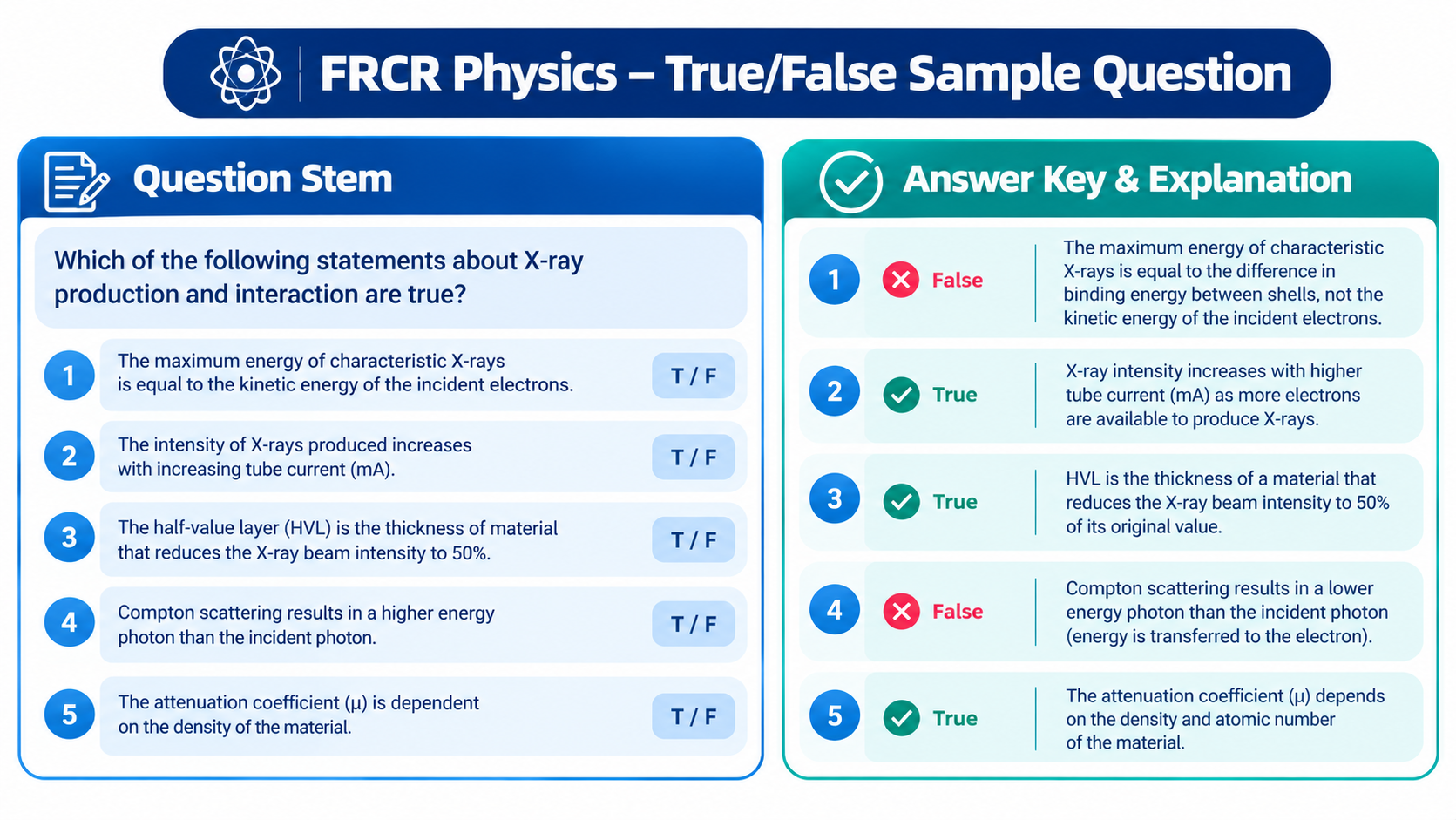
Effective FRCR physics practice is about learning from each item, not counting how many you have done. After every set, go back through every item you got wrong and every item you got right by guessing. For each one, write a single line in your error log explaining the principle.
Here is an example of the style, written to illustrate the format rather than copied from any exam.
Regarding diagnostic ultrasound:
- (a) The speed of sound in soft tissue is approximately 1540 m/s. True.
- (b) A higher-frequency transducer gives greater depth of penetration. False. Higher frequency improves resolution but attenuates faster, so penetration falls.
- (c) Acoustic impedance is the product of tissue density and the speed of sound in that tissue. True.
- (d) Shortening the spatial pulse length improves axial resolution. True.
- (e) The Doppler shift is greatest when the beam is perpendicular to flow. False. At 90 degrees the shift approaches zero; it is greatest when the beam is parallel to flow.
Notice how one FRCR physics stem tests five separate ideas, and how two items hinge on a trade-off. Writing the reason next to each answer is what turns practice into retained knowledge.
Common traps in FRCR physics
The traps that cost marks here are mostly about reading and habit rather than knowledge. Watch for absolute words such as “always”, “never” and “only”, which are often false in a field built on trade-offs. Read units and directions carefully: “increases” and “decreases” can be swapped by one word in a long stem.
Other traps are worth naming. Revising from old notes that predate IRR17 and IR(ME)R 2017 can leave you answering safety items to outdated rules. Spending too long on molecular imaging wastes time on sections not currently examined. And memorising phrases from question banks without understanding them fails as soon as the wording changes.
If you want structured support, StudyFRCR has an FRCR Part 1 course; see the course page for what it includes.
Timing on the day
In the FRCR physics paper, two hours for 40 questions gives you three minutes per stem, which is about 36 seconds per item. That is comfortable if you keep moving, but it disappears quickly if you agonise over one stem.
In FRCR physics, a practical rhythm is to aim to finish a first pass by around 90 minutes, flagging stems you want to revisit. Use the rest of your time in the physics module for flagged stems, and make sure every item has an answer before time runs out. Physics and anatomy are on consecutive days, so plan rest and travel for both; dates are on our FRCR exam dates page.
Frequently asked questions
Is FRCR physics negatively marked?
No. Each correct true/false item scores one mark and each wrong item scores zero, so you should answer every item.
How many questions are in the physics module?
There are 40 questions, each with five true/false items, giving 200 items in two hours.
Can all five items in a stem be true?
Yes. Any number of items can be true or false, including all five true or all five false.
Do I need a calculator for FRCR physics?
No. The RCR states that a calculator is not needed.
Which radiation regulations should I study?
Physics questions are based on IRR17 and IR(ME)R 2017, so revise from material that reflects those regulations.
Is molecular imaging examined?
The RCR guidance notes say syllabus sections 4.22 to 4.24 on molecular imaging are not currently examined. Check the latest guidance notes before your sitting.
Ready to build your physics plan? Explore the FRCR Part 1 course or Talk to our FRCR team.
Related guides: FRCR Part 1 exam format · FRCR anatomy guide · FRCR Part 1 preparation · FRCR exam dates
Sources: RCR: FRCR Part 1 Radiology (CR1) · RCR: CR1 guidance notes for candidates · RCR: Clinical radiology curriculum