
Good FRCR Part 1 preparation starts about three to four months before your sitting, with a written study plan that runs physics and anatomy in parallel and finishes with timed mocks. For a resident that usually means 16 weeks if you are working full time, or 12 weeks if you can protect more hours each week.
This guide covers when to start, whether to sit one module or both, two week-by-week plans, studying around duties, mocks, the final fortnight and the mistakes that cost marks.
Table of Contents
When to start your FRCR Part 1 preparation
Start once you are settled in a radiology training post and have chosen a sitting, then count back about 16 weeks. You need that post before you can enter, because the RCR requires a current or past training post in clinical radiology or a related discipline, not just a medical degree. If you are not sure your post counts, check with the RCR Exams Office and read our FRCR eligibility guide.
For MD and DNB Radiodiagnosis residents in India, once eligibility is confirmed, the early part of residency is a natural window. Your anatomy is fresh, you are seeing large volumes of CT and MRI, and physics links directly to the protocols you are learning. Gulf-based doctors in training posts can use the same logic.
Remember the booking deadline when you set your start date. Bookings close at least eight weeks before the exam and late entries are not accepted, so for the March 2027 sitting you must book by Friday 8 January 2027. Check every date on our FRCR exam dates page.
One module or both in a sitting
You can take physics and anatomy at the same sitting or at different sittings, in either order, so the choice is yours. Both must be passed within four years of passing the first, which gives you room to split them if you need to.
Sitting both together suits you if your rota is predictable and you can give each module steady weekly time. It keeps momentum and gets the First FRCR done in one go. Splitting suits you if your duties are heavy, if one subject is clearly weaker, or if you would rather pay for and travel to one module at a time. There is no single right answer, but do not split simply to delay the harder module.
| Approach | Suits you if | Watch out for |
| Both modules, one sitting | Stable rota, 12 to 16 weeks available | Physics often gets squeezed by anatomy practice |
| Physics first | Physics is your weaker subject | Anatomy can feel rushed later if you leave it too long |
| Anatomy first | Strong image exposure from daily reporting | Physics concepts take time to settle |
For the exact format of each module, see our FRCR Part 1 exam guide.
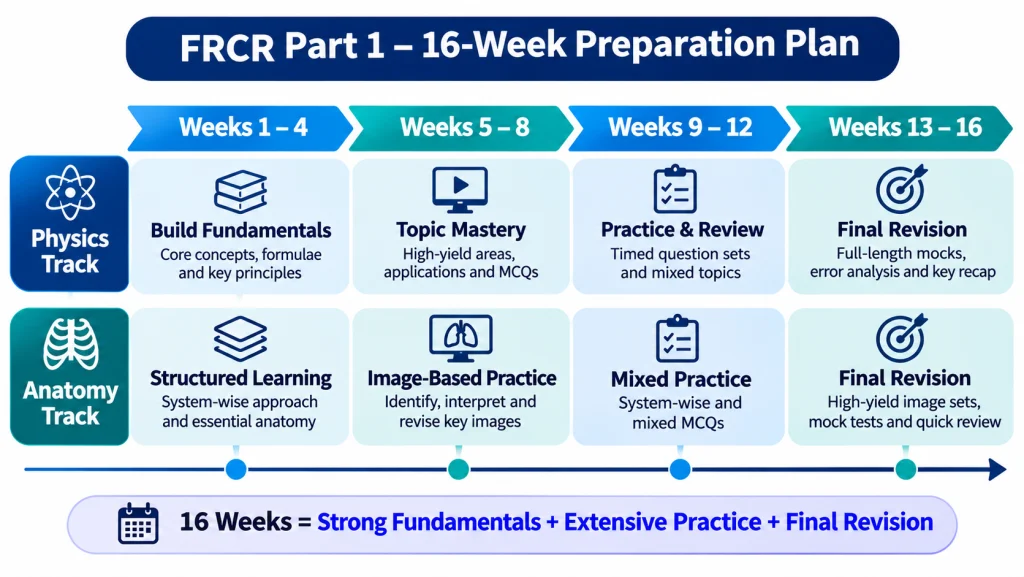
A 16-week study plan for both modules
A 16-week study plan gives a working resident roughly 10 to 12 hours a week, which is realistic alongside a full rota. The idea is to build physics understanding early, when you have the most energy, and to keep anatomy ticking over with daily image practice throughout.
| Weeks | Physics focus | Anatomy focus |
| 1 to 2 | Matter and radiation, X-ray production | Daily 20 images; head and neck basics |
| 3 to 4 | Radiography and fluoroscopy, dose | Chest and cardiovascular |
| 5 to 6 | Computed tomography | Abdomen and pelvis |
| 7 to 8 | Ultrasound | Musculoskeletal, upper limb |
| 9 to 10 | Magnetic resonance imaging | Musculoskeletal, lower limb and spine |
| 11 to 12 | Radionuclide imaging, radiation safety and regulations | Neuroanatomy |
| 13 to 14 | Mixed question banks, weak topics | Mixed regions and modalities, timed sets |
| 15 | Full timed physics mock | Full timed anatomy mock |
| 16 | Review errors, light revision | Review errors, rest before the exam |
The physics blocks cover every topic in the RCR’s published question distribution, where six of the 40 questions come from each of six major topics. Keep the official specimen questions back for the later weeks so they act as a true test.
A 12-week study plan if time is shorter
A 12-week study plan works if you can find 14 to 16 hours a week, for example during a lighter posting. It compresses the same content, so you need discipline about finishing each block before moving on.
| Weeks | Physics focus | Anatomy focus |
| 1 to 2 | Matter and radiation, radiography, fluoroscopy | Head, neck and chest |
| 3 to 4 | Computed tomography, ultrasound | Abdomen, pelvis and cardiovascular |
| 5 to 6 | Magnetic resonance imaging | Musculoskeletal and spine |
| 7 to 8 | Radionuclide imaging, radiation safety | Neuroanatomy |
| 9 to 10 | Mixed questions, weak topics | Mixed timed sets |
| 11 | Full mocks for both modules | Full mocks for both modules |
| 12 | Targeted review and rest | Targeted review and rest |
If 12 weeks looks impossible with your current duties, choose a later sitting or split the modules. A rushed attempt still counts towards the six-attempt limit.
Studying around duties and on-call
FRCR Part 1 preparation fits around clinical work best in short, regular blocks rather than long weekend sessions. Thirty to forty minutes before a shift, a set of anatomy images in a quiet moment and one longer physics session on a day off add up quickly over a few months.
Use your reporting list as part of the study plan. When you see a structure on a scan, name it precisely and with its side, as you would in the anatomy module. When you set up a protocol, ask why the parameters are chosen, because that is the kind of reasoning physics stems test. After a night on call, swap physics for lighter image review rather than forcing new theory.
Study groups help with accountability. Two or three colleagues quizzing each other on anatomy once a week, or explaining a physics concept aloud, can reveal gaps that solo reading hides.
Mocks and timed practice
Timed mocks are where your FRCR Part 1 preparation turns into exam performance. Physics gives you two hours for 40 questions, about three minutes per stem, and anatomy gives you 90 minutes for 100 images, under a minute each.
Sit at least one full mock for each module in exam conditions, in one go, without notes. Mark the result, then spend longer reviewing your errors than you spent on the mock itself. Because neither module is negatively marked, practise answering every item; a habit of leaving blanks costs marks for no reason.
The RCR publishes physics specimen questions and an anatomy advice document under candidate resources on the CR1 exam page, and offers an interactive demonstration of the Assess platform. Use them. If you want structured support for CR1, StudyFRCR has an FRCR Part 1 course; see the course page for what it includes.
The final two weeks and common mistakes
In the final two weeks, stop starting new topics. Rework your error log, repeat short timed sets and protect your sleep, especially the night before each module, since physics and anatomy fall on consecutive days.
These are common mistakes in FRCR Part 1 preparation:
- Reading physics passively without testing yourself on true/false items.
- Leaving items blank even though there is no negative marking.
- Naming structures vaguely or forgetting laterality in anatomy.
- Doing no full-length timed mock, then running short of time on the day.
- Booking late and missing the window, or choosing a sitting before checking eligibility.
- Ignoring the official RCR resources in favour of unofficial notes alone.
For detail on each module, read our FRCR physics guide and FRCR anatomy guide.
Frequently asked questions
How many weeks of FRCR Part 1 preparation do I need?
Around 16 weeks suits a resident working full time, and 12 weeks can work if you protect more hours each week. Start from your chosen sitting and count back.
Should I sit physics and anatomy together?
Sit both if your rota is stable and you can give each module steady time. Split them if duties are heavy or one subject is much weaker, remembering the four-year rule.
Can I start preparing before I have a radiology post?
You can read ahead, but you cannot enter CR1 without a current or past training post in clinical radiology or a related discipline. Plan your sitting once you are in that post.
How many mocks should I sit?
At least one full timed mock per module, followed by careful error review. More short timed sets in the final weeks also help.
Is there negative marking in either module?
No. Physics scores one mark per correct item and anatomy scores two, one or zero per image, so answer everything.
What are the best official resources?
The RCR’s physics specimen questions, anatomy advice document, guidance notes and the Assess demonstration, all linked from the CR1 exam page.
Want a structured route through both modules? See the FRCR Part 1 course or Talk to our FRCR team.
Related guides: FRCR Part 1 exam format · FRCR physics guide · FRCR anatomy guide · FRCR preparation across all parts
Sources: RCR: FRCR Part 1 Radiology (CR1) · RCR: CR1 guidance notes for candidates · RCR: Exam regulations and policies