

FRCR results are released on a fixed date for each sitting, about three weeks after the exam for Part 1 and Part 2A: the next ones are the November 2026 Part 2A results on 26 November 2026, followed by the March 2027 Part 1 results on 1 April 2027. Whatever your outcome, the useful question is what you do in the week after, and that depends on which part you sat.
This guide covers results dates for every current sitting, how the Royal College of Radiologists (RCR) releases them, and your next steps after a pass or a fail.
Table of Contents
FRCR results dates for 2026 and 2027
Every sitting has a published results date, listed on the RCR exam page alongside the exam and booking dates. The tables below give the current FRCR results dates for Part 1 (CR1) and Part 2A (CR2A).
| Part 1 sitting | Exam days | Results |
| March 2027 | Thu 11 Mar / Fri 12 Mar 2027 | Thu 1 Apr 2027 |
| June 2027 | Thu 10 Jun / Fri 11 Jun 2027 | Thu 1 Jul 2027 |
| September 2027 | Thu 9 Sep / Fri 10 Sep 2027 | Thu 30 Sep 2027 |
| Part 2A sitting | Exam days | Results |
| November 2026 | Tue 3 Nov / Wed 4 Nov 2026 | Thu 26 Nov 2026 |
| April 2027 | Tue 20 Apr / Wed 21 Apr 2027 | Thu 13 May 2027 |
| November 2027 | Tue 2 Nov / Wed 3 Nov 2027 | Thu 25 Nov 2027 |
For Part 2B, the October 2026 results came out on 5 November 2026, and the 2027 sittings have results due on 25 February, 13 May, 22 July and 4 November 2027. You will find the full booking calendar in our FRCR exam dates guide.
How FRCR results are released
For Part 1, the RCR publishes a pass list by candidate number on its website, showing passes overall and by module. Every candidate is also emailed a results letter with their module scores and the level needed to pass.
That letter is the most valuable part of your FRCR results, pass or fail. It tells you how far above or below the line you were in each module, which is far more useful than the pass list alone when you plan what comes next. Keep it with your study notes.
For Part 2A and Part 2B, check the relevant RCR exam page for how results are released at that sitting. Two practical points apply to everyone:
- For Part 1, know your candidate number before results day, so you can check the pass list quickly.
- Keep your RCR membership active. Cancelling membership before the exam, or within a year of sitting at the member fee, can mean a delay in releasing your results or re-booking at the standard fee.
The pass mark is not a fixed number. For each Part 1 module, it is set by a modified Angoff method and finalised after the exam with the Hofstee compromise method, so it can move from one sitting to the next. Our FRCR pass rates guide shows how much pass rates vary between sittings.
After passing Part 1: next module or Part 2A
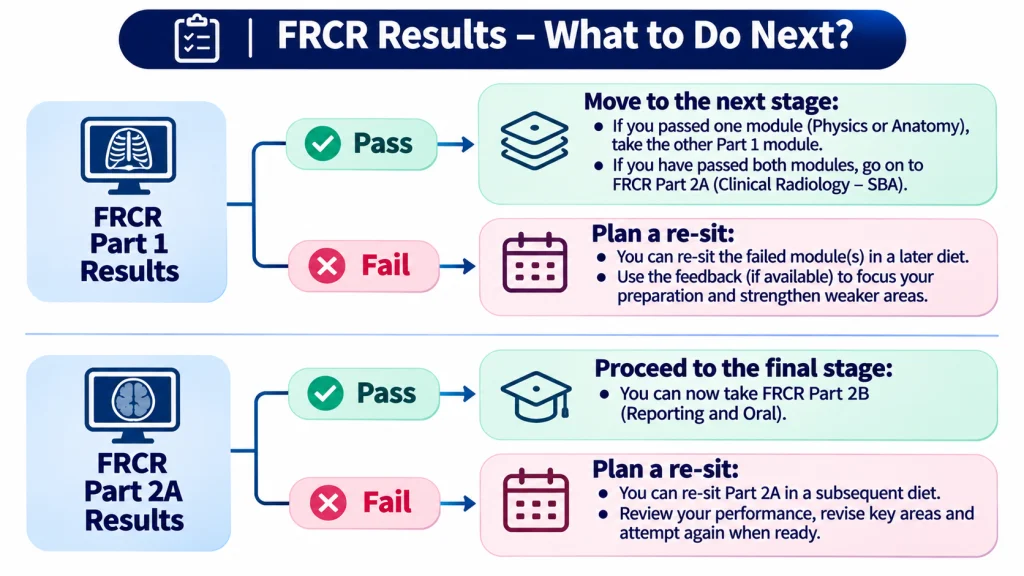
If your FRCR results show a pass in one Part 1 module, your next job is the other module, and the clock is now running. Both physics and anatomy must be passed within four years of passing the first one.
Four years sounds generous, but residency has a way of filling it. A sensible approach is to book the remaining module for the next or second-next sitting, while the exam routine is still fresh. If you passed physics, for example, a June or September anatomy sitting keeps your momentum.
Once both modules are passed, you have completed the First FRCR. You can then enter Part 2A for the next seven calendar years; after that, you would need to re-sit all or part of Part 1. Part 2A also expects at least 22 months in a relevant training post by the exam month, which the RCR describes as a guide for international candidates to the extent of training required. Our FRCR Part 2A exam format guide explains what the next stage looks like.
| Result | Time limit that now applies |
| First Part 1 module passed | Second module within four years of that pass |
| Both Part 1 modules passed | Enter Part 2A within the next seven calendar years |
| Part 2A passed | Enter Part 2B within the next seven calendar years |
After passing Part 2A: preparing for Part 2B
When your FRCR results confirm a Part 2A pass, you move to the final stage, with a seven-year window to enter Part 2B. After that, you may be asked to re-sit Part 2A.
Part 2B has two reporting components (short cases and long cases) and an oral, all taken at the same sitting on a computer workstation; it was changed in 2025. Entry expects 32 months in a relevant training post, again a guide for international candidates. Because demand for 2B places abroad is high, plan your booking as soon as your Part 2A result is confirmed. Our Part 2B course is launching later: register your interest.
What to do if you did not pass
A fail is a setback, not a verdict on you as a radiologist. Start by reading the letter that comes with your FRCR results carefully: your module score against the pass level tells you whether you were close or whether your approach needs to change.
Then check how many attempts you have left before you decide anything else. The RCR allows a maximum of six attempts at any FRCR exam, as specified by the GMC. Cancelled exams and withdrawals do not count towards that limit, and the CR1 guidance notes add that the limit is backdated to include earlier attempts.
When you plan the re-sit, be honest about timing. Booking the very next sitting can work if you missed by a small margin and your knowledge is solid. If you were further off, or your FRCR results reflect a busy rota and little protected study time, an extra sitting’s gap with a proper plan is usually the wiser choice. Remember that bookings close at least eight weeks before each exam, so your decision window is shorter than it looks.
This is also the right moment to change how you study rather than simply doing more of the same. Our FRCR Part 1 preparation guide includes 12-week and 16-week plans you can adapt for a re-sit.
Using your results to plan the next sitting
The best use of FRCR results is as data for your next plan. Whether you passed or not, spend an evening that week writing down what worked, what did not, and which topics felt weakest on the day.
For a Part 1 re-sit, focus on question practice under timed conditions: physics with 40 stems of five true or false items in two hours, anatomy with 100 images in 90 minutes. For Part 2A, that means two full papers of 120 single best answer questions, three hours each.
If you want structure, StudyFRCR has a Part 1 course and a Part 2A course: see each course page for what it includes. We do not publish our own results claims; the RCR pass list and your letter are the figures that count.
Frequently asked questions
When are the next FRCR results released?
The November 2026 Part 2A results are due on Thursday 26 November 2026. The next Part 1 results, for the March 2027 sitting, are due on Thursday 1 April 2027.
How do I find out my Part 1 result?
The RCR publishes a pass list by candidate number on its website, overall and by module. You also receive an emailed results letter with your module scores and the level needed to pass.
Is the pass mark the same at every sitting?
No. It is set for each sitting using a modified Angoff method and finalised after the exam with the Hofstee compromise method, so the number can change.
How long do I have after passing one Part 1 module?
You must pass the second module within four years of passing the first one.
How many times can I attempt each part?
You have a maximum of six attempts at any FRCR exam. Cancelled exams and withdrawals do not count.
Can my FRCR results be delayed?
Yes, in some cases. Cancelling your RCR membership before the exam, or within a year of sitting at the member fee, can delay the release of your results.
Planning your next step after results day? Talk to our FRCR team or look at the FRCR Part 2A course.
Related guides:
Sources: