
The FRCR Part 1 exam is made up of two separate modules, physics and radiological anatomy, which you can sit at the same sitting or at different ones and pass in any order. Physics is 40 questions, each with five true/false items, in two hours, and anatomy is 100 images in 90 minutes. Once both are passed, you hold the First FRCR and can move towards Part 2A.
This guide covers each module’s format and marking, the time limits that apply, 2027 dates and venues, who can enter, and how to turn the format into a sensible study plan.
Table of Contents
What the FRCR Part 1 exam is
This exam, which the Royal College of Radiologists (RCR) labels CR1, is the first of three stages towards Fellowship of the RCR in clinical radiology. The later stages are Final FRCR Part A (CR2A) and Final FRCR Part B (CR2B). Part 1 tests the foundations you will rely on for the rest of your career: the physics behind every imaging modality and the anatomy you need to recognise on real images.
The two modules are held on separate days across two days, three times a year, normally in March, June and September. You do not have to pass them together. The RCR treats the First FRCR as achieved once both modules are passed, whichever order you take them in.
It helps to keep the clinical oncology FRCR out of your mind here. It is a separate exam series with its own parts, and nothing in this guide applies to it.
The two modules at a glance
The quickest way to understand the FRCR Part 1 exam is to compare the two modules side by side. They test different skills, run on different platforms and are marked in different ways.
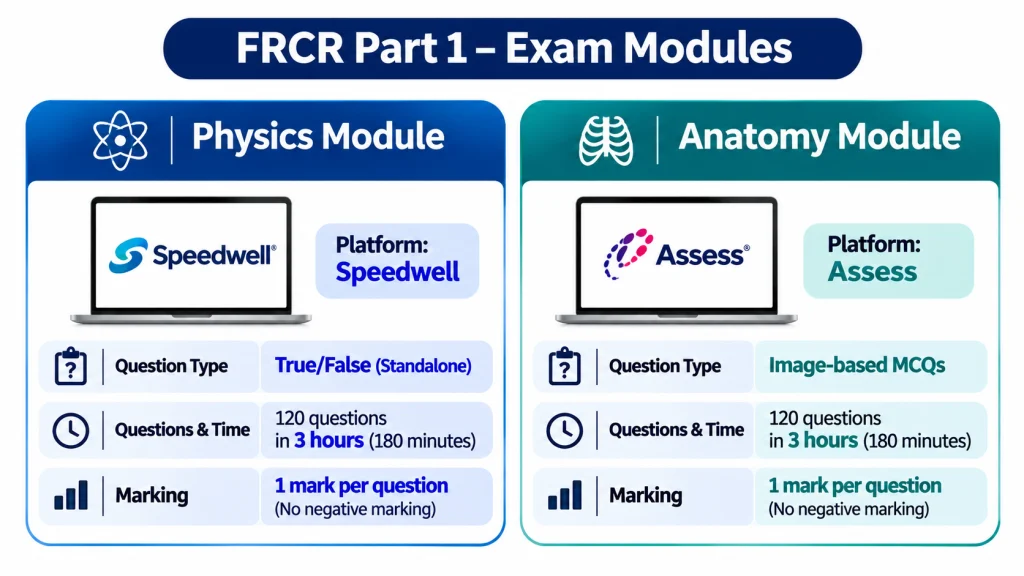
| Physics module | Anatomy module | |
| Questions | 40 questions, each with a stem and five items, (a) to (e) | 100 images, each with one structure marked by an arrow or arrows |
| What you answer | Each item true or false | A single question about the marked structure |
| Time | 2 hours | 90 minutes |
| Platform | Speedwell | Assess (image-viewing platform) |
| Marking | +1 per correct item, 0 per wrong item | +2 completely accurate, +1 less accurate but correct, 0 incorrect |
| Negative marking | None | None |
| Calculator | Not needed | Not applicable |
Both modules use a pass mark set by a modified Angoff method, with the final pass mark decided after the exam using the Hofstee compromise method. The RCR does not publish a fixed pass mark, and it notes that the cohort and pass rate vary from sitting to sitting.
How the physics module works
The physics module gives you 40 questions in two hours, delivered on Speedwell. Each question has a stem followed by five items, and you mark each item true or false independently. Any combination is possible, so all five items can be true, or all five can be false.
Because there is no negative marking, a wrong answer costs you nothing beyond the mark you would have gained. The RCR encourages candidates to answer every question, and that is the right instinct: never leave an item blank. Two hours for 40 stems works out at three minutes per stem, which is generous if you know the material and tight if you are unsure.
The RCR publishes how the 40 questions are distributed across topics.
| Physics topic | Questions |
| Matter and radiation | 3 |
| Radiography and fluoroscopy | 6 |
| Radionuclide imaging | 6 |
| Radiation safety | 6 |
| Computed tomography | 6 |
| Magnetic resonance imaging | 6 |
| Ultrasound | 6 |
| Other | 1 |
Two further points from the RCR guidance notes are worth knowing. Syllabus sections 4.22 to 4.24 on molecular imaging are not currently examined, and physics questions are based on IRR17 and IR(ME)R 2017. For a full strategy, read our FRCR physics guide.
How the anatomy module works
The anatomy module shows you 100 images in 90 minutes on Assess, the RCR’s image-viewing platform. On each image one structure is marked by one or more arrows, and there is a single question about it. That is under a minute per image, so speed of recognition matters as much as knowledge.
Marking rewards precision. A completely accurate answer scores two marks, a less accurate but still correct answer scores one, and an incorrect answer scores nothing. Answers that do not exactly match the platform’s accepted list are reviewed by examiners, so a sensible answer with a minor spelling slip is not automatically lost, but you should still aim for exact, specific terms with the correct side stated.
The RCR offers an interactive demonstration of Assess on its website. Try it before the day so the viewing tools feel familiar. Our FRCR anatomy guide covers naming, laterality and an eight-week plan.
Sitting the modules: order, timing and the four-year rule
You can take the physics and anatomy modules of the FRCR Part 1 exam at the same sitting or at different sittings, in either order. What you cannot do is leave them indefinitely. Both modules must be passed within four years of passing the first one.
Two more limits shape your planning. Once you complete the First FRCR, you can enter Part 2A for the next seven calendar years; after that, all or part of Part 1 must be re-sat. There is also a maximum of six attempts at any FRCR exam. Cancelled exams and withdrawals do not count, and the limit is backdated to include earlier attempts.
| Rule | What it means for you |
| Any order | Physics first, anatomy first, or both together |
| Four-year rule | Pass the second module within four years of passing the first |
| Seven-year window | Enter Part 2A within seven calendar years of completing Part 1 |
| Six attempts | Maximum per exam; cancellations and withdrawals do not count |
Whether to sit one module or both in a sitting is a personal call, and we discuss it in our FRCR Part 1 preparation guide.
2027 dates, venues and fees
The FRCR Part 1 exam runs three times in 2027, with physics on the Thursday and anatomy on the Friday. Members get an earlier booking window than non-members, and bookings close about two months before each sitting.
| Sitting | Physics / Anatomy | Member bookings open | Non-member bookings open | Bookings close | Results |
| Mar 2027 | Thu 11 / Fri 12 Mar | Tue 6 Oct 2026 | Tue 13 Oct 2026 | Fri 8 Jan 2027 | Thu 1 Apr 2027 |
| Jun 2027 | Thu 10 / Fri 11 Jun | Tue 15 Dec 2026 | Tue 22 Dec 2026 | Fri 9 Apr 2027 | Thu 1 Jul 2027 |
| Sep 2027 | Thu 9 / Fri 10 Sep | Tue 6 Apr 2027 | Tue 13 Apr 2027 | Fri 9 Jul 2027 | Thu 30 Sep 2027 |
CR1 is held at UK venues (Belfast, Bridgend, Edinburgh, Leeds, London, Manchester and Plymouth) and internationally in Egypt, Hong Kong, India (Hyderabad), Malaysia, Pakistan and Singapore. Hyderabad is the only Indian venue, and no Gulf venue is listed, so doctors in the UAE, Qatar, Saudi Arabia and neighbouring countries need to travel. Venues can change by sitting, so confirm on the Exam Hub when you book.
Fees are charged per module in pounds sterling. At Hyderabad a module costs £912 for members and £1,214 for non-members in 2027. For every venue, plus what the rupee or dirham cost depends on, see our FRCR fees guide and FRCR exam dates page.
Who can sit Part 1 and how to book
To enter the FRCR Part 1 exam you need a primary medical degree from a school listed in the World Directory of Medical Schools and a training post in clinical radiology or a related discipline, either now or in the past. The RCR guidance describes this as a formal clinical radiology training post in which you are actively receiving training. A medical degree on its own is not enough.
If you are an MD or DNB Radiodiagnosis resident in India, do not assume your post counts. What counts as a training post outside the UK is not spelled out in detail, so check your eligibility with the RCR Exams Office before you book. Our FRCR eligibility guide walks through the rules for India and the Gulf.
Booking is done through the RCR Exam Hub using a single RCR website account. The RCR says “Do not create another account”, so sign in with the one you already have. Fees are paid at booking, and late entries are not accepted.
Using the format to plan your preparation
The format of the FRCR Part 1 exam should drive how you study. Physics rewards understanding over memorised phrases, because five independent true/false items will probe the same concept from several angles. Anatomy rewards volume of image exposure and precise naming, because you have under a minute per image.
A practical approach is to work through the official physics specimen questions and the anatomy advice document listed under candidate resources on the CR1 page, then build timed practice around them. If you want structured support alongside your residency, StudyFRCR has an FRCR Part 1 course; see the course page for what it includes.
Keep the later stages in view too. Part 2A asks you to apply this physics and anatomy in clinical contexts, so the effort you put in now pays off again later.
Frequently asked questions
How many modules are in the FRCR Part 1 exam?
There are two modules: physics and radiological anatomy. You can take them together or at different sittings, in any order, and you hold the First FRCR once both are passed.
Is there negative marking in FRCR Part 1?
No. Physics gives one mark per correct true/false item and nothing for a wrong one, and anatomy scores two, one or zero per image. Answer every item.
How long is each module?
Physics is two hours for 40 questions, and anatomy is 90 minutes for 100 images. They are held on separate days.
Do I need a calculator for the physics module?
No. The RCR states that a calculator is not needed for the physics module.
Can any MBBS graduate sit the FRCR Part 1 exam?
No. Alongside a medical degree, you need a current or past training post in clinical radiology or a related discipline. Check with the RCR Exams Office if you are unsure whether your post counts.
How long do I have to pass both modules?
You must pass the second module within four years of passing the first. After completing Part 1, you have seven calendar years to enter Part 2A.
Where can I sit CR1 in India?
Hyderabad is the only Indian venue listed. There is no venue in the Gulf, so Gulf-based doctors travel to Hyderabad or another listed venue.
Ready to plan your Part 1 sitting? Explore the FRCR Part 1 course or Talk to our FRCR team.
Related guides: FRCR physics guide · FRCR anatomy guide · FRCR Part 1 preparation · FRCR exam datesSources:RCR: FRCR Part 1 Radiology (CR1) · RCR: CR1 guidance notes for candidates · RCR: Exam regulations and policies · RCR: Clinical radiology curriculum