

Your career after FRCR depends far more on where you want to work than on the exam itself, because each country’s regulator decides what the qualification counts for. In the UK, the Royal College of Radiologists says the FRCR can be used by doctors trained outside the UK as an alternative to PLAB for GMC registration; in India and the Gulf, you need to check the national regulator’s current rules before relying on it.
This guide covers what the FRCR is designed to do, the UK, India and Gulf positions in careful terms, how to plan your next step, and how to get Part 1 and Part 2A done first.
Table of Contents
What a career after FRCR can look like
Good planning starts with what the RCR itself says the exam is for. The RCR describes the FRCR as a major part of UK specialty training assessment in clinical radiology and the main entry point to Fellowship of the RCR. It also says doctors trained outside the UK can use it on the route into the GMC Medical Register, and that it can be valuable evidence in a Specialist Register application through the equivalence process (CESR).
Notice what that list does not say. It makes no promise about jobs, pay or recognition in any other country. That is why the honest answer to “what can I do with the FRCR qualification?” always ends with “check the regulator where you want to work”.
| Where you want to work | What to check | Who decides |
| United Kingdom | GMC registration and specialist registration requirements | GMC |
| India | Whether the FRCR counts for your post, including teaching posts | NMC |
| UAE | The Unified PQR and your licensing authority | MOHAP, DOH Abu Dhabi, DHA or SHA |
| Qatar, Saudi Arabia, Oman, Kuwait, Bahrain | The regulator’s current requirements | The national health regulator |
The UK: GMC registration and specialist training
For a career after FRCR in the UK, the key body is the General Medical Council, not the RCR. The RCR says the FRCR can be used by doctors trained outside the UK as an alternative to PLAB for GMC registration. Check the GMC’s current requirements before you plan around this, because the GMC sets and updates its own rules.
Within the UK, the FRCR qualification is built into specialty training in clinical radiology, and UK specialty trainees must be enrolled with the RCR. If you are aiming for the Specialist Register, the RCR lists the FRCR as possible evidence for an application through the equivalence route (CESR). How a specific application is judged is a matter for the GMC.
If the UK is your goal, start early with the practical steps: an RCR website account, membership if it suits you, and a clear sitting plan. Our what is FRCR guide explains how the three parts fit together.
India: how the FRCR sits alongside MD and DNB
In India, MD Radiodiagnosis and DNB Radiodiagnosis are Indian postgraduate qualifications in radiology, and the FRCR qualification does not replace them. The safe position is this: FRCR is not, on its own, listed as equivalent to MD or DNB Radiodiagnosis in India; check the NMC’s current rules before relying on it for jobs or teaching posts in India.
Two points support that caution. The NMC states that it does not process individual applications for equivalence of foreign qualifications. And under the Teachers Eligibility Qualifications (TEQ) 2022 rules, as reported by Medical Dialogues, the UK route to equivalence with MD or MS for teaching posts needs CCST or equivalent training with FRCS or FRCP, plus registration to practise in that specialty in the UK. FRCR is not named in that route.
So for a career after FRCR in India, think of the FRCR as an addition to your MD or DNB, not a substitute. Teaching posts in medical colleges follow NMC rules, so read the current regulations before you assume the FRCR changes your eligibility. Our FRCR after MD radiology guide looks at timing the exam around Indian residency.
The UAE and the Unified PQR
In the UAE, the document to read is the Unified Healthcare Professional Qualification Requirements (PQR), now in its third version and shared by MOHAP, DOH Abu Dhabi, DHA and SHA. You can find it on the DOH PQR page.
How the PQR classifies the FRCR qualification, whether for a specialist or consultant title or any tier, is not something we can confirm here. Check the PQR and your licensing authority directly before you plan a career after FRCR in the UAE, and keep copies of your results letters and certificates ready for any licensing application.
Other Gulf countries: check the regulator first
For Qatar, Saudi Arabia, Oman, Kuwait and Bahrain, check the regulator’s current requirements before you make any decision based on the FRCR qualification. Rules for licensing and titles can change, and the regulator’s own published requirements are the only reliable guide.
A sensible habit is to write down three things for each country you are considering: which regulator licenses radiologists, which qualifications it currently lists, and whether experience requirements apply as well. Doing this before you sit Part 2A means your career after FRCR is planned around real requirements rather than assumptions.
Remember too that no Gulf country has a listed FRCR venue. You will travel to sit each part, so our FRCR exam centres guide is worth reading alongside this one.
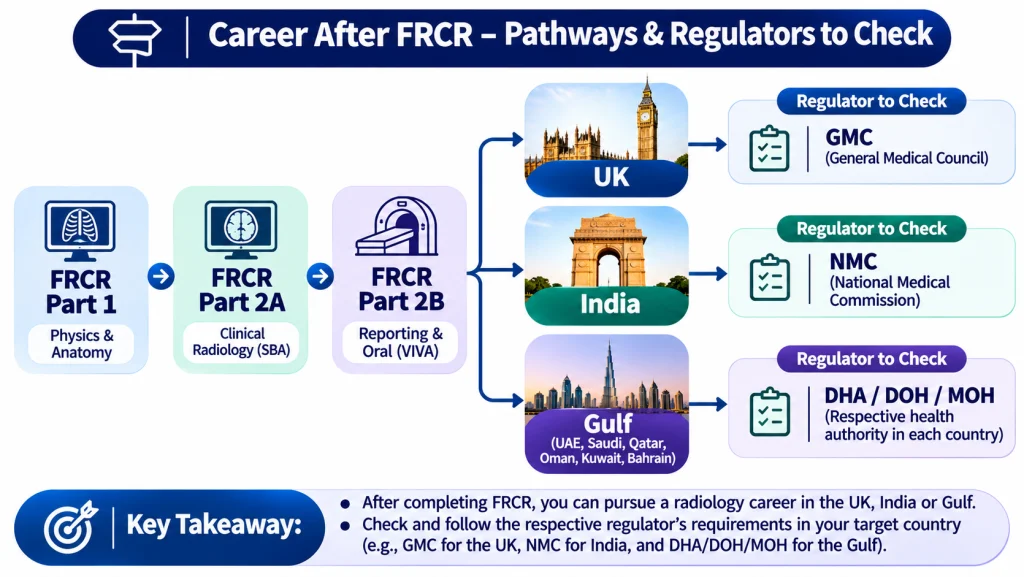
Planning your next step, country by country
The best decisions about a career after FRCR start with the destination and work backwards to the exam plan. Use this table as a planning checklist; it contains no promises, only the order in which to ask questions.
| Stage | What to do |
| Before Part 1 | Confirm you hold a clinical radiology training post (current or past) and check eligibility with the RCR Exams Office |
| After Part 1 | Note your seven-year window to enter Part 2A and check your target regulator’s rules |
| Before Part 2A | Check your training time against the 22 months in a relevant post (a guide for international candidates) |
| After Part 2A | Plan Part 2B within seven years and start licensing paperwork |
| After the full FRCR | Apply to the regulator for your chosen country with its current requirements in hand |
You may also want to look at StudyMEDIC’s clinical programme in radiology alongside the training in your own department.
Part 2B matters for completing the FRCR, but StudyFRCR’s Part 2B course is launching later: register your interest.
Getting there: Part 1 and Part 2A first
Every career after FRCR begins with passing Part 1, and Part 1 needs a current or past clinical radiology training post, not just a medical degree. The two modules, physics and anatomy, can be taken in any order, but both must be passed within four years of passing the first.
Part 2A follows, with two papers of 120 single best answer questions each. If you are preparing now, StudyFRCR has courses for FRCR Part 1 and FRCR Part 2A; see each course page for what it includes. The FRCR preparation guide sets out a realistic timeline for the whole journey.
Frequently asked questions
Does the FRCR qualification let me work in the UK?
The RCR says the FRCR can be used by doctors trained outside the UK as an alternative to PLAB for GMC registration. Check the GMC’s current requirements, because the GMC decides registration.
Is FRCR equivalent to MD Radiodiagnosis in India?
FRCR is not, on its own, listed as equivalent to MD or DNB Radiodiagnosis in India. Check the NMC’s current rules before relying on it for jobs or teaching posts.
Can I teach in an Indian medical college with the FRCR?
Teaching posts follow NMC rules, and the TEQ 2022 UK route as reported does not name FRCR. Read the NMC’s current regulations before assuming the FRCR qualifies you.
How does the UAE classify the FRCR?
We cannot confirm how the PQR classifies the FRCR. Check the PQR and your licensing authority (MOHAP, DOH Abu Dhabi, DHA or SHA) for the current position.
What about a career after FRCR in Saudi Arabia or Qatar?
Check the regulator’s current requirements in that country before you plan. Rules can change, so rely on the regulator’s own published documents.
Should I plan my career after FRCR before finishing the exams?
Yes. Planning early helps, because knowing your target country’s rules can shape how and when you sit Part 2A and Part 2B.
Talk to our FRCR team: contact us to plan your exams around your career goals, or explore the FRCR Part 1 course and the FRCR Part 2A course.
Related guides:
Sources: