
What is FRCR? It is the Fellowship of the Royal College of Radiologists (RCR) in the UK, earned by passing a three-stage FRCR exam in clinical radiology: Part 1 (physics and anatomy), Part 2A and Part 2B. For radiology residents and radiologists in India and the Gulf, the practical news is that you can sit every stage in Hyderabad.
This guide covers the structure of each part, who can sit it, attempts and time limits, venues, recognition, and how long the journey usually takes.
Table of Contents
What is FRCR, and who awards it?
The FRCR is awarded by the Royal College of Radiologists, and passing the clinical radiology exams is the main entry point to Fellowship of the College. When people ask what is FRCR, they usually mean this clinical radiology pathway, which is also a major part of UK specialty training assessment in radiology.
The RCR describes several purposes for the FRCR exam. It assesses UK specialty trainees. The RCR also says it can be used by doctors trained outside the UK as an alternative to PLAB for GMC registration; check the GMC’s current requirements. It can also be valuable evidence for a GMC Specialist Register application through the equivalence process (CESR).
A separate clinical oncology FRCR also exists, with its own exams. This guide, like everything on StudyFRCR, covers clinical radiology only.
The three parts of the FRCR exam
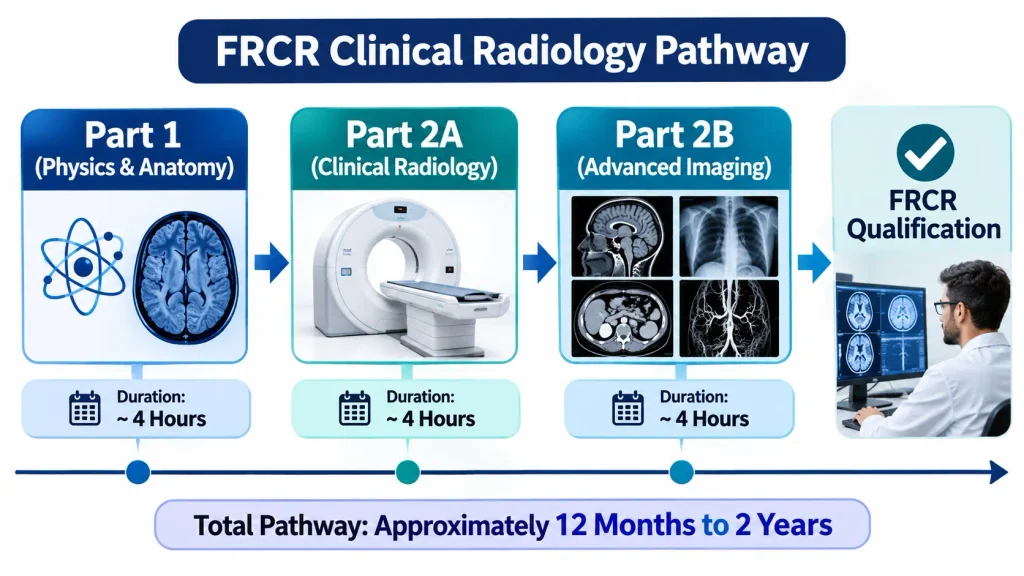
The clinical radiology FRCR exam has three stages, taken in order: the First FRCR (Part 1, known as CR1), Final FRCR Part A (CR2A) and Final FRCR Part B (CR2B). The table gives the shape of each one.
| Stage | What it tests | Format | Sittings |
| Part 1 (CR1): physics | Physics for radiology | 40 questions, each with five true or false items, in two hours, on Speedwell | Normally March, June, September |
| Part 1 (CR1): anatomy | Radiological anatomy | 100 images in 90 minutes, on Assess | Same two-day sittings as physics |
| Part 2A (CR2A) | All aspects of clinical radiology plus physics, anatomy and techniques | Two papers of 120 single best answer questions, three hours each, on Speedwell | Normally April and November |
| Part 2B (CR2B) | Reporting and oral | Short cases, long cases and an oral at one sitting | Several sittings a year |
Part 1 has two modules that you can take at the same sitting or separately, in any order. Neither physics nor anatomy is negatively marked, so every answer is worth attempting. Our FRCR Part 1 exam guide explains both modules in detail.
Part 2A covers cardiothoracic and vascular, musculoskeletal and trauma, gastro-intestinal, genito-urinary (with adrenal, obstetrics and gynaecology and breast), paediatric, and central nervous system with head and neck. The 240 questions are treated as one assessment, with no pass or fail for each paper. See our Part 2A exam format guide.
Part 2B has two reporting components (short cases and long cases) and an oral, all taken at the same sitting on a computer workstation; it was changed in 2025. Our Part 2B course is launching later: register your interest.
Who can sit the FRCR exam?
To sit any part, you need a primary medical degree such as MBBS from a school listed in the World Directory of Medical Schools, and you must hold (or have held) a training post in clinical radiology or a related discipline. That second condition is the one people miss. Part 1 is not open to every MBBS graduate: it is for doctors who are in, or have been in, a formal radiology training post.
If you are an MD or DNB Radiodiagnosis resident, do not assume your post counts. What counts as a training post in India or the Gulf is not spelt out on the RCR pages, so check your eligibility with the RCR Exams Office before you book.
| Stage | Entry expectation |
| Part 1 | Medical degree and a current or past clinical radiology (or related) training post |
| Part 2A | First FRCR passed, plus at least 22 months in a relevant training post by the exam month |
| Part 2B | Part 2A passed, plus 32 months in a relevant training post |
The 22- and 32-month training times apply to UK resident doctors in formal programmes; for international candidates, the RCR says they are a guide to the extent of training required. All exams are in English, and the RCR expects English equivalent to IELTS 7.5, although no test result is needed in advance. Full detail is in our FRCR eligibility guide.
Attempts, time limits and booking rules
You have a maximum of six attempts at any FRCR exam, as specified by the GMC, and that limit is the first thing to understand about planning. Cancelled exams and withdrawals do not count towards that limit.
The time limits shape your whole plan:
- Both Part 1 modules must be passed within four years of passing the first one.
- After completing Part 1, you can enter Part 2A for the next seven calendar years.
- After completing Part 2A, you can enter Part 2B for the next seven calendar years.
Bookings close at least eight weeks before each exam, and late entries are not accepted. You book, cancel and reschedule through the RCR Exam Hub using one RCR website account. RCR members get priority booking and reduced fees, which matters when overseas seats fill quickly. Our FRCR exam dates guide lists every current booking window.
Where you can sit the exams
Hyderabad is the only Indian venue listed for any part of the clinical radiology FRCR exam, and it hosts Part 1, Part 2A and Part 2B. Other international venues vary by part.
| Stage | Venues listed by the RCR |
| Part 1 | UK, Egypt, Hong Kong, India (Hyderabad), Malaysia, Pakistan, Singapore |
| Part 2A | UK, Egypt, Hong Kong, India (Hyderabad), Pakistan, Singapore |
| Part 2B | UK, Egypt, India (Hyderabad), Pakistan |
No Gulf venue is listed for any part. If you work in the UAE, Qatar, Saudi Arabia, Oman, Kuwait or Bahrain, you will travel to a listed venue such as Hyderabad, Egypt, Pakistan or the UK. Fees are charged in pounds sterling and differ by venue; our FRCR fees guide sets them out.
Recognition: what the FRCR can and cannot do for you
What is FRCR worth outside the UK? The honest answer is that it depends on the country and the regulator, so check before you rely on it for a specific job.
In the UK, the RCR says the FRCR can support GMC registration as an alternative to PLAB and can be evidence in a CESR application. In India, FRCR is not, on its own, listed as equivalent to MD or DNB Radiodiagnosis; check the NMC’s current rules before relying on it for jobs or teaching posts in India. In the UAE, the health authorities share a Professional Qualification Requirements document, so check the PQR and your licensing authority. For Qatar, Saudi Arabia, Oman, Kuwait and Bahrain, check the regulator’s current requirements.
Our guide to career after FRCR looks at these routes in more depth.
How long does the FRCR take?
There is no single answer, because it depends on when you start and how your training is structured. In general, the pathway runs across several years of radiology training rather than a few months.
One possible pattern, once your eligibility is confirmed, is Part 1 during residency, then Part 2A once around 22 months of training is complete (a guide for international candidates), then Part 2B later. Each step of the FRCR exam needs months of preparation alongside full clinical work, so planning a year ahead helps. If you are deciding where to start, our FRCR preparation guide maps out a realistic timeline.
When you are ready for structured support, StudyFRCR has courses for FRCR Part 1 and FRCR Part 2A: see each course page for what it includes.
Frequently asked questions
What is FRCR in simple terms?
It is the Fellowship of the Royal College of Radiologists, earned by passing three stages of clinical radiology exams: Part 1, Part 2A and Part 2B.
Can any MBBS doctor sit FRCR Part 1?
No. You need a medical degree and a current or past training post in clinical radiology or a related discipline. Check your eligibility with the RCR Exams Office if you are unsure.
How many attempts do I get?
A maximum of six attempts at any FRCR exam. Cancelled exams and withdrawals do not count.
Can I sit the FRCR exam in India?
Yes. Hyderabad is listed as a venue for Part 1, Part 2A and Part 2B.
Is FRCR equivalent to MD Radiodiagnosis in India?
FRCR is not, on its own, listed as equivalent to MD or DNB Radiodiagnosis in India. Check the NMC’s current rules before relying on it for jobs or teaching posts.
Is there a separate oncology FRCR?
Yes, a separate clinical oncology FRCR exists with its own exams. StudyFRCR covers the clinical radiology pathway only.
Want help planning your first step? Talk to our FRCR team or explore the FRCR Part 1 course.
Related guides:
Sources: