
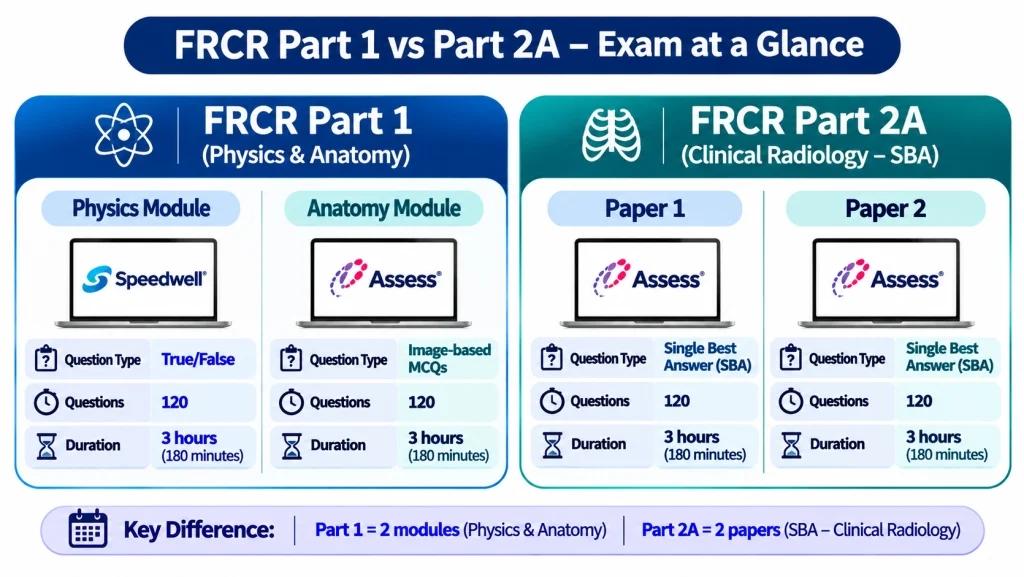
The FRCR Part 2A exam is two papers of 120 single best answer questions each, three hours per paper, delivered on Speedwell twice a year, normally in April and November. You can enter once you have passed the whole First FRCR, and the RCR’s 22 months of relevant training acts as a guide for international candidates.
This guide covers the paper format, marking and pass mark, entry rules and time windows, current dates, venues and fees, and how 2A differs from Part 1.
Table of Contents
What the FRCR Part 2A exam looks like
The RCR calls this exam CR2A, and it is a written assessment of 240 questions split across two three-hour papers. Each question has a stem followed by five options, (a) to (e), and you choose the one best answer. The table below sets out the essentials as the RCR publishes them.
| Feature | What the RCR says |
| Papers | Two, sat on consecutive days |
| Questions | 120 per paper, 240 in total |
| Time | Three hours for each paper |
| Question type | Single best answer, five options (a) to (e) |
| Platform | Speedwell |
| Sittings | Twice a year, normally April and November |
| Marking | +1 for a correct answer, 0 for a wrong one; no negative marking |
| In the exam | A reference sheet with normal ranges and common abbreviations |
| Calculator | Not needed |
You may bring writing implements if you want to use scrap paper. Three hours for 120 questions works out at 90 seconds per question, which sounds generous until you meet a long stem with five closely matched options. Pacing is therefore a skill you train for, not something you leave to the day.
The “single best” part matters. Several options will often be defensible, and the question asks which one is most correct for that patient and that finding. That is closer to a reporting decision than a recall test.
What CR2A covers
The RCR describes the CR2A syllabus as “all aspects of clinical radiology and the basic sciences of physics, anatomy and techniques”. The guidance notes group the clinical content into these areas:
- cardiothoracic and vascular
- musculoskeletal and trauma
- gastro-intestinal
- genito-urinary, adrenal, obstetrics and gynaecology and breast
- paediatric
- central nervous and head and neck
You are examined against the Specialty Training Curriculum for Clinical Radiology, so read that document yourself rather than relying on second-hand topic lists. The RCR does not publish a fixed number of questions per area in the material we rely on, so plan to cover every system rather than betting on a favourite.
The CR2A page also lists official candidate resources: specimen questions, a page on understanding the single best answer format, TNM staging guidance and the candidate reference sheet. Work through all four early. The reference sheet in particular shows which normal ranges and abbreviations are provided in the exam.
How marking and the pass mark work
Marking is simple: one mark for each correct answer and nothing deducted for a wrong one, so you should answer every question. There is no pass or fail for each paper; the RCR treats all 240 questions as one assessment.
The pass mark is set by a modified Angoff method, with the highest and lowest scorers removed, and the final pass mark is decided after the exam using the Hofstee compromise method. Questions that perform poorly can be removed after review, and the pass mark is adjusted to match. The RCR does not publish a fixed pass mark number, so be wary of anyone who quotes one.
In practice this means a tough first paper does not, on its own, decide your result. Stay steady for paper two. If you want to see how results have varied between sittings, our guide to FRCR pass rates sets out the published figures.
Who can sit the FRCR Part 2A exam
To enter you need to have passed all of the First FRCR (both physics and anatomy) and, by the exam month, to have spent at least 22 months in a relevant training post. The 22 months is a formal minimum for UK resident doctors in training programmes; for international candidates the RCR says it is a guide to the extent of training required.
The general regulations still apply. You need a primary medical degree from an institution in the World Directory of Medical Schools and a current or past training post in clinical radiology or a related discipline. What counts as a training post for doctors in India or the Gulf is not spelt out in the material we rely on, so check your eligibility with the RCR Exams Office before you book. Our FRCR eligibility guide walks through each part.
Three time rules shape your planning:
| Rule | What it means for you |
| Attempts | Maximum six attempts at any FRCR exam; cancellations and withdrawals do not count |
| Window after First FRCR | You can enter Part 2A for the next seven calendar years; after that, all or part of the First FRCR must be re-sat |
| Window after Part 2A | You can enter Part 2B for the next seven calendar years; after that, you may have to re-sit Part 2A |
All parts are in English. The RCR says your English should be equivalent to IELTS 7.5, but no test result or evidence of language ability is needed in advance.
FRCR Part 2A exam dates, venues and fees
The next sitting with open booking is April 2027; resident doctor and member bookings opened on 20 October 2026 and non-member bookings on 27 October 2026. Bookings close at least eight weeks before each exam, late entries are not accepted, and fees are paid when you book.
| Sitting | Paper 1 / Paper 2 | Member bookings open | Non-member bookings open | Bookings close | Results |
| Nov 2026 | Tue 3 Nov / Wed 4 Nov 2026 | Mon 2 Feb 2026 | Mon 9 Feb 2026 | Fri 4 Sep 2026 | Thu 26 Nov 2026 |
| Apr 2027 | Tue 20 Apr / Wed 21 Apr 2027 | Tue 20 Oct 2026 | Tue 27 Oct 2026 | Fri 19 Feb 2027 | Thu 13 May 2027 |
| Nov 2027 | Tue 2 Nov / Wed 3 Nov 2027 | Tue 2 Feb 2027 | Tue 9 Feb 2027 | Fri 3 Sep 2027 | Thu 25 Nov 2027 |
Booking priority runs in three groups: RCR members who are resident doctors in UK training programmes, then RCR members, then non-members. Membership also brings reduced exam fees while it stays in good standing, and any membership application must be complete before you book. Our FRCR exam dates page tracks every part.
CR2A is held at UK venues and in Egypt, Hong Kong, India (Hyderabad), Pakistan and Singapore. Hyderabad is the only Indian venue, and no Gulf country has a listed venue, so doctors in the UAE, Qatar, Saudi Arabia, Oman, Kuwait or Bahrain travel to one of these. See FRCR exam centres for India and the Gulf for travel planning.
| Venue | Apr and Nov 2027 member | Apr and Nov 2027 non-member |
| UK | £562 to £668 | £889 |
| India (Hyderabad) | £942 | £1,253 |
| Egypt | £706 | £939 |
| Pakistan | £706 | £939 |
| Hong Kong | £924 | £1,229 |
| Singapore | £1,095 | £1,457 |
Fees are charged in pounds sterling, so what you pay in rupees or dirhams depends on the exchange rate and your card or bank charges on the day. Our FRCR fees guide adds the Part 1 costs.
How the FRCR Part 2A exam differs from Part 1
The biggest change from Part 1 to 2A is the move from recognising facts to making clinical judgements. Part 1 asks whether a physics statement is true or what an arrowed structure is; 2A asks what the most likely diagnosis, next investigation or best descriptor is.
| Feature | Part 1 (CR1) | Part 2A (CR2A) |
| Structure | Two modules: physics and anatomy | Two papers treated as one assessment |
| Questions | Physics: 40 stems, each with five true/false items. Anatomy: 100 images | 120 single best answer questions per paper |
| Time | Physics two hours; anatomy 90 minutes | Three hours per paper |
| Platform | Speedwell (physics), Assess (anatomy) | Speedwell |
| Marking | Physics +1 per correct item; anatomy +2, +1 or 0 | +1 correct, 0 wrong |
| Passing | Each module passed separately | One result across 240 questions |
| Sittings | Three a year, normally March, June, September | Twice a year, normally April and November |
| Entry | Medical degree plus a current or past training post | First FRCR passed plus the 22-month guide |
If you are still at the Part 1 stage, start with our FRCR Part 1 exam guide. The anatomy and physics you learnt there resurface in 2A, now inside clinical scenarios.
Getting started on your 2A plan
The best first step is to sit one set of official specimen questions under timed conditions and see where you stand. That baseline tells you which systems need the most weeks and whether pacing at 90 seconds per question is already a problem.
From there, build a plan system by system, alongside your daily reporting list. Our FRCR 2A preparation guide has 16-week and 12-week plans. If you want structured support, StudyFRCR has an FRCR Part 2A course; see the course page for what it includes.
Looking further ahead, Part 2B has two reporting components (short cases and long cases) and an oral, all taken at the same sitting on a computer workstation; it was changed in 2025. Our Part 2B course is launching later: register your interest.
Frequently asked questions
How many questions are in the FRCR Part 2A exam?
There are 240 questions in total, split into two papers of 120. Each is a single best answer question with five options.
How long is each Part 2A paper?
Each paper lasts three hours. That gives you an average of 90 seconds per question.
Is there negative marking in CR2A?
No. A correct answer scores one mark and a wrong answer scores zero, so answer every question.
Do I have to pass each paper separately?
No. The RCR treats all 240 questions as one assessment, and there is no pass or fail for each paper.
Can I sit Part 2A before passing both Part 1 modules?
No. You must have passed all of the First FRCR, and the 22 months of relevant training acts as a guide for international candidates.
Is there a Part 2A venue in the Gulf?
No Gulf venue is listed for CR2A. Hyderabad is the Indian venue, and other options include Egypt, Pakistan, Hong Kong, Singapore and the UK.
Do I need IELTS for the FRCR?
No test is needed in advance. The RCR says your English should be equivalent to IELTS 7.5.
Ready to plan your sitting? Explore the FRCR Part 2A course or Talk to our FRCR team.
Related guides: What is FRCR · FRCR 2A preparation · FRCR exam dates · FRCR pass rates
Sources: RCR: FRCR Part 2A (CR2A) · RCR: CR2A guidance notes for candidates · RCR: exam regulations and policies · RCR: clinical radiology curriculum