
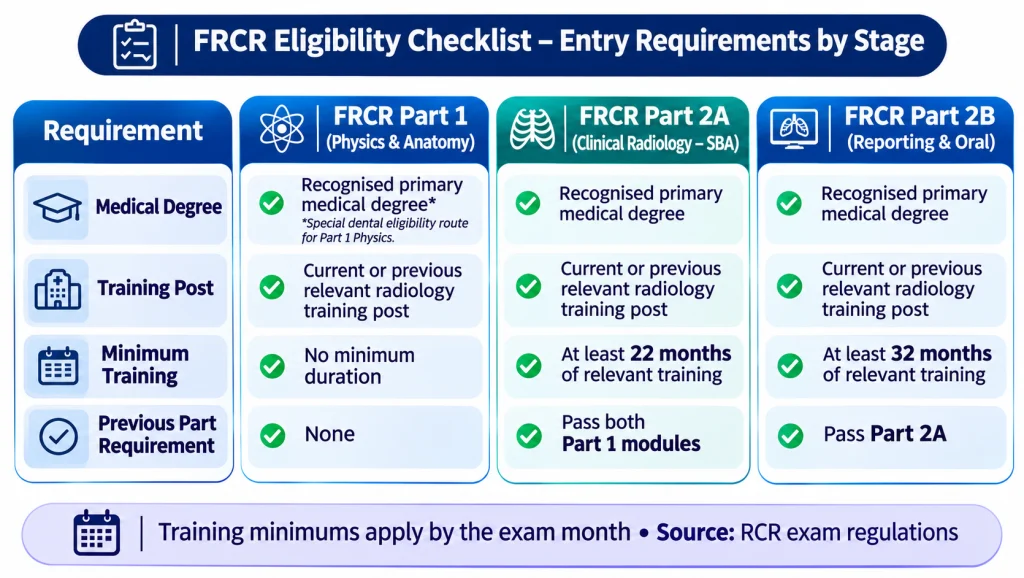
FRCR eligibility starts with two conditions for every stage: a primary medical degree such as MBBS from a listed medical school, and a current or past training post in clinical radiology or a related discipline. Part 2A then adds a pass in Part 1 and a guide of 22 months of training, and Part 2B adds a Part 2A pass and a guide of 32 months.
This guide covers the rules for each part, what they mean for MD and DNB Radiodiagnosis residents and Gulf doctors, the English level, attempts and time limits.
Table of Contents
FRCR eligibility at a glance
The Royal College of Radiologists (RCR) sets the same core entry rules for all candidates, with extra conditions as you move up the stages. The table summarises them.
| Stage | Medical degree | Training post | Training time | Previous stage |
| Part 1 (CR1) | Required | Current or past clinical radiology (or related) post | None stated | None |
| Part 2A (CR2A) | Required | Required | At least 22 months by the exam month (a guide for international candidates) | First FRCR passed |
| Part 2B (CR2B) | Required | Required | 32 months (a guide for international candidates) | Part 2A passed |
Two further rules apply across the board. The RCR gives no exemption from any part on the basis of experience or other qualifications, so an MD or DNB does not let you skip a stage. And doctors erased from the GMC register or an equivalent international body for fitness-to-practise reasons cannot enter, while suspended doctors must wait until the suspension is lifted.
Part 1: degree plus a radiology training post
For Part 1, you need a primary medical degree from an institution listed in the World Directory of Medical Schools, and you must be in a training post in clinical radiology or a related medical discipline, or have held one in the past. The RCR gives nuclear medicine and breast clinician training as examples of related disciplines.
The CR1 guidance notes put it plainly: candidates should be in “a formal clinical radiology training post in which they are actively receiving clinical radiology training (or to have held such a post in the past)”. That is why FRCR eligibility for Part 1 is not open to every MBBS graduate. If you are a doctor without a radiology post, the route is to get into radiology training first and plan Part 1 from there.
The RCR sets no required length of general clinical (non-radiological) experience. If you are a non-member, you must provide evidence of your medical degree.
What counts as a training post in India and the Gulf?
The RCR pages do not list which Indian or Gulf posts count, so the safe answer is to check your eligibility with the RCR Exams Office before you book. Do this early, not in the week the booking window closes.
For Indian doctors in MD or DNB Radiodiagnosis training, the question is whether your post meets the RCR wording. When you contact the Exams Office, describe your post clearly: your institution, the programme, your start date and the radiology training you are receiving. Have your degree evidence ready too.
For doctors in the Gulf, the same approach applies. If you hold or have held a radiology residency or training post, explain its structure to the RCR and ask whether it meets the requirement. Do not assume that a general hospital job in an imaging department counts on its own.
Once you know you are eligible, the next step is planning a sitting. StudyFRCR has a Part 1 course: see the course page for what it includes.
Part 2A and Part 2B: the 22 and 32 month guides
FRCR eligibility for Part 2A needs two things: all of the First FRCR passed, and at least 22 months in a relevant training post by the exam month. For Part 2B, you need Part 2A passed and 32 months in a relevant training post.
Here is the detail that confuses many international doctors. The RCR applies these minimum training times to UK resident doctors in formal training programmes. Other candidates may attempt the exams but “should be guided by these timings as to the extent of training required”. So treat 22 and 32 months as a guide for international candidates to how much training you need before you are ready, rather than as a rule you can ignore.
In practice, an MD or DNB resident who passes Part 1 early in training would use the 22-month guide to judge when Part 2A becomes realistic. Our FRCR Part 2A exam format guide explains what that stage involves, and the StudyFRCR Part 2A course can support your preparation.
Part 2B has two reporting components (short cases and long cases) and an oral, all taken at the same sitting on a computer workstation; it was changed in 2025. Our Part 2B course is launching later: register your interest.
English language: the IELTS 7.5 guide
All parts of the FRCR are in English. The RCR says your English should be equivalent to IELTS 7.5, but you do not need an IELTS or any other test, and no evidence of language ability is needed in advance.
That means English is not a booking barrier, but it is a readiness question. Part 2A, for example, is two papers of 120 single best answer questions in three hours each, so slow reading of long stems costs time. If English is not your first language, build timed reading into your practice.
Identity rules matter too. If you are not registered with the GMC, you must enter the exam in the name on your passport, and a passport is expected when you sit outside your country of residence.
Attempts and validity windows
You have a maximum of six attempts at any FRCR exam, as specified by the GMC. Cancelled exams and withdrawals do not count, and the CR1 guidance notes add that the limit is backdated to include earlier attempts.
The time limits are just as important for FRCR eligibility as the entry rules:
| Point reached | What you must do next |
| First Part 1 module passed | Pass the second module within four years |
| First FRCR completed | Enter Part 2A within the next seven calendar years, or re-sit all or part of Part 1 |
| Part 2A completed | Enter Part 2B within the next seven calendar years, or you may need to re-sit Part 2A |
Bookings close at least eight weeks before each exam, and late entries are not accepted. RCR membership gives priority booking and reduced fees, but your membership application must be complete before you book. Our FRCR exam dates guide lists the current windows, and the FRCR fees guide covers member and non-member costs.
Frequently asked questions
I am an MD Radiodiagnosis resident in India. Am I eligible for Part 1?
The rule asks for a formal clinical radiology training post in which you are actively receiving radiology training. Describe your MD or DNB post to the RCR Exams Office and confirm your FRCR eligibility before you book.
Can an MBBS graduate without a radiology post sit Part 1?
No. You need a current or past training post in clinical radiology or a related discipline, as well as your medical degree.
I work as a radiologist in the Gulf. Which part can I sit?
If you hold or have held a radiology training post, you can start with Part 1, then move to Part 2A once Part 1 is passed. Check with the RCR Exams Office that your training post meets the requirement.
Do I need 22 months of training before Part 2A?
For UK resident doctors in formal programmes, yes. For international candidates, the RCR says the 22 months is a guide to the extent of training required.
Do I need an IELTS score?
No test or evidence is needed in advance. The RCR expects English equivalent to IELTS 7.5.
Does my MD or DNB exempt me from any part?
No. The RCR gives no exemption from any part on the basis of experience or other qualifications.
How many attempts do I get?
A maximum of six attempts at any FRCR exam. Cancelled exams and withdrawals do not count.
Unsure where you stand? Talk to our FRCR team or explore the FRCR Part 1 course.
Related guides:
- What is FRCR
- FRCR after MD radiology
- FRCR Part 1 exam format
- FRCR exam centres for India and the Gulf
Sources: